OCR Private Cloud Deployments
OCR Private Cloud Deployments
EnterFlow AI
•
Mar 16, 2018
OCR Private Cloud Deployments
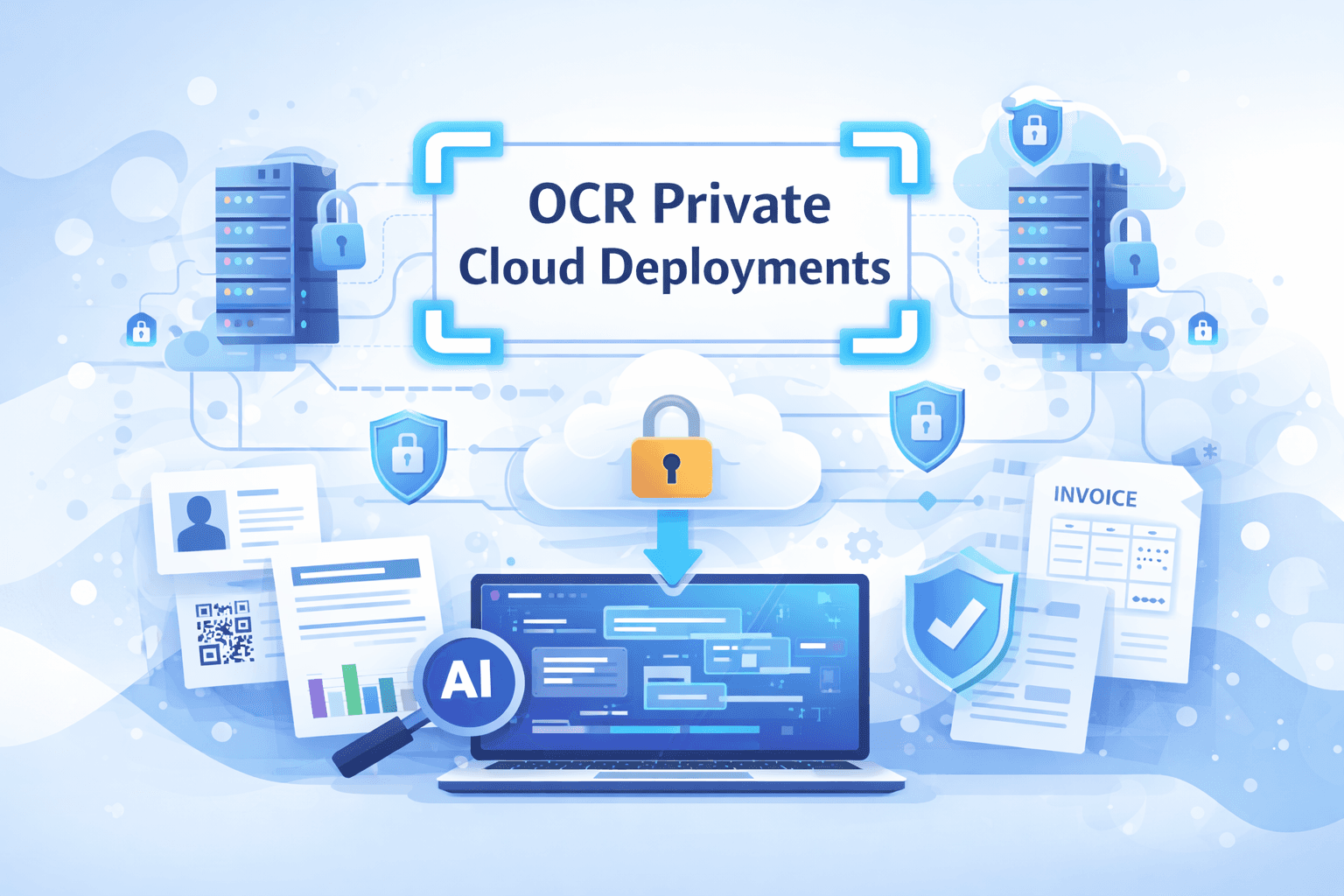
When document data is sensitive—financial records, customer PII, contracts, healthcare, or regulated operations—many teams want OCR and document AI deployed inside a private cloud environment with strong controls over access, networking, and data residency.
Enterflow delivers OCR pipelines and document workflows as private-cloud deployments in your chosen platform: AWS, Microsoft Azure, or Google Cloud—with architecture options ranging from fully customer-managed to fully managed single-tenant environments.
What “Private Cloud OCR” means (in plain terms)
A private cloud deployment typically includes:
Single-tenant infrastructure (your own isolated environment)
Private networking (no public endpoints required)
Encryption everywhere (in transit and at rest)
Strict access control (IAM / RBAC, least privilege, audit logs)
Data residency controls (choose region, keep data in-tenant)
Operational guardrails (monitoring, alerting, backups, retention policies)
For non-technical teams: your documents stay within a controlled environment and access is provable.
For technical teams: you get an auditable, hardened deployment aligned to enterprise patterns.
Deployment models (choose the right control level)
Option A — Deployed in your cloud account (customer-managed)
Best for: strict governance, regulated environments, internal security requirements
You control: billing, networking, keys, IAM policies, runtime, logs
We provide: infrastructure templates, deployment automation, and support
Option B — Single-tenant private environment (Enterflow-managed, isolated)
Best for: fast rollout while still requiring isolation and private networking
You get: dedicated tenant, private endpoints, strict access boundaries
We operate: infrastructure, upgrades, observability, incident response (as contracted)
Option C — Hybrid private deployments
Best for: staged adoption or mixed constraints (e.g., data must remain on one side)
Example: store documents in your storage account; processing runs in a private compute tier; only extracted structured data flows to downstream systems
Reference architecture (typical components)
A production-grade private OCR deployment commonly includes:
Ingress: API endpoints behind private networking, authenticated requests
Storage: encrypted document store + extracted results store
Processing: OCR workers (CPU) and optional GPU nodes for VLM-based extraction
Queueing: reliable job orchestration for bursty loads and retries
Database: metadata, job states, configurations, audit events
Observability: metrics, logs, traces, alerting, dashboards
Security controls: key management, secrets, IAM/RBAC, network policies
Cloud-specific options
AWS (Amazon Web Services)
Common private-cloud patterns:
Networking: VPC with private subnets, security groups, NACLs
Compute: ECS/Fargate or EKS for containerized OCR workers; EC2 for specialized workloads
Storage: S3 (documents/results), EBS/EFS where needed
Queueing: SQS (jobs), SNS (notifications)
Database: RDS (Postgres) or DynamoDB (metadata)
Secrets/keys: AWS KMS, Secrets Manager
Logging/monitoring: CloudWatch, CloudTrail
Private connectivity: PrivateLink, VPC peering, site-to-site VPN, Direct Connect
Best when you want strong ecosystem breadth, mature networking options, and flexible scaling patterns.
Microsoft Azure
Common private-cloud patterns:
Networking: VNet with private subnets, NSGs, private DNS
Compute: AKS (Kubernetes), Azure Container Apps, or VM scale sets
Storage: Azure Blob Storage / Data Lake
Queueing: Service Bus or Storage Queues
Database: Azure Database for PostgreSQL or Cosmos DB
Secrets/keys: Key Vault, customer-managed keys (CMK)
Logging/monitoring: Azure Monitor, Log Analytics
Private connectivity: Private Link, VNet peering, VPN Gateway, ExpressRoute
Best when you operate primarily in Microsoft environments (Azure AD / Entra ID, Microsoft security stack, enterprise governance).
Google Cloud Platform (GCP)
Common private-cloud patterns:
Networking: VPC, private subnets, firewall rules, private DNS
Compute: GKE (Kubernetes), Cloud Run (private), or Compute Engine
Storage: Cloud Storage (GCS)
Queueing: Pub/Sub (jobs/events), Cloud Tasks for controlled execution
Database: Cloud SQL (Postgres) or Firestore (metadata)
Secrets/keys: Cloud KMS, Secret Manager
Logging/monitoring: Cloud Logging, Cloud Monitoring
Private connectivity: Private Service Connect, VPC peering, Cloud VPN, Interconnect
Best when you want strong data/ML-native services and clean private service connectivity patterns.
Security and compliance controls (what we implement)
Private deployments usually include:
No public access (private endpoints only, optional IP allowlists)
Encryption in transit (TLS) and at rest
Customer-managed keys (optional) and key rotation policies
Least-privilege IAM/RBAC and separation of duties
Audit logging (who accessed what, and when)
Retention controls (automatic purge policies, legal holds where required)
Environment separation (dev/staging/prod)
If needed, we also support additional controls like dedicated encryption domains, SIEM forwarding, and custom approval flows for high-risk actions.
Performance and scaling (key operational data)
We design around measurable targets such as:
Throughput: documents/hour at peak load
Latency: time from upload to structured output
Exception rate: percentage requiring human review
Cost per document: predictable unit economics with autoscaling
Reliability: retry logic, dead-letter queues, idempotency, and monitoring SLAs
How to choose between AWS, Azure, and GCP
In most cases, the best choice is the cloud you already standardize on. If you are deciding fresh:
Choose AWS for maximum flexibility and broad service coverage
Choose Azure for deep Microsoft integration and enterprise governance alignment
Choose GCP for strong data/ML primitives and clean event-driven patterns
We can deploy the same core OCR system across all three, adapting to your platform’s native services and security model.
Next steps
To scope a private OCR deployment, we typically align on:
your required region/data residency,
your preferred cloud (AWS/Azure/GCP),
expected volume and peak throughput,
security constraints (private endpoints, CMK, audit logging, retention),
integration points (ERP, AP system, ticketing, data warehouse).
Contact: info@enterflow.ai
Website: https://enterflow.ai/
OCR Private Cloud Deployments
When document data is sensitive—financial records, customer PII, contracts, healthcare, or regulated operations—many teams want OCR and document AI deployed inside a private cloud environment with strong controls over access, networking, and data residency.
Enterflow delivers OCR pipelines and document workflows as private-cloud deployments in your chosen platform: AWS, Microsoft Azure, or Google Cloud—with architecture options ranging from fully customer-managed to fully managed single-tenant environments.
What “Private Cloud OCR” means (in plain terms)
A private cloud deployment typically includes:
Single-tenant infrastructure (your own isolated environment)
Private networking (no public endpoints required)
Encryption everywhere (in transit and at rest)
Strict access control (IAM / RBAC, least privilege, audit logs)
Data residency controls (choose region, keep data in-tenant)
Operational guardrails (monitoring, alerting, backups, retention policies)
For non-technical teams: your documents stay within a controlled environment and access is provable.
For technical teams: you get an auditable, hardened deployment aligned to enterprise patterns.
Deployment models (choose the right control level)
Option A — Deployed in your cloud account (customer-managed)
Best for: strict governance, regulated environments, internal security requirements
You control: billing, networking, keys, IAM policies, runtime, logs
We provide: infrastructure templates, deployment automation, and support
Option B — Single-tenant private environment (Enterflow-managed, isolated)
Best for: fast rollout while still requiring isolation and private networking
You get: dedicated tenant, private endpoints, strict access boundaries
We operate: infrastructure, upgrades, observability, incident response (as contracted)
Option C — Hybrid private deployments
Best for: staged adoption or mixed constraints (e.g., data must remain on one side)
Example: store documents in your storage account; processing runs in a private compute tier; only extracted structured data flows to downstream systems
Reference architecture (typical components)
A production-grade private OCR deployment commonly includes:
Ingress: API endpoints behind private networking, authenticated requests
Storage: encrypted document store + extracted results store
Processing: OCR workers (CPU) and optional GPU nodes for VLM-based extraction
Queueing: reliable job orchestration for bursty loads and retries
Database: metadata, job states, configurations, audit events
Observability: metrics, logs, traces, alerting, dashboards
Security controls: key management, secrets, IAM/RBAC, network policies
Cloud-specific options
AWS (Amazon Web Services)
Common private-cloud patterns:
Networking: VPC with private subnets, security groups, NACLs
Compute: ECS/Fargate or EKS for containerized OCR workers; EC2 for specialized workloads
Storage: S3 (documents/results), EBS/EFS where needed
Queueing: SQS (jobs), SNS (notifications)
Database: RDS (Postgres) or DynamoDB (metadata)
Secrets/keys: AWS KMS, Secrets Manager
Logging/monitoring: CloudWatch, CloudTrail
Private connectivity: PrivateLink, VPC peering, site-to-site VPN, Direct Connect
Best when you want strong ecosystem breadth, mature networking options, and flexible scaling patterns.
Microsoft Azure
Common private-cloud patterns:
Networking: VNet with private subnets, NSGs, private DNS
Compute: AKS (Kubernetes), Azure Container Apps, or VM scale sets
Storage: Azure Blob Storage / Data Lake
Queueing: Service Bus or Storage Queues
Database: Azure Database for PostgreSQL or Cosmos DB
Secrets/keys: Key Vault, customer-managed keys (CMK)
Logging/monitoring: Azure Monitor, Log Analytics
Private connectivity: Private Link, VNet peering, VPN Gateway, ExpressRoute
Best when you operate primarily in Microsoft environments (Azure AD / Entra ID, Microsoft security stack, enterprise governance).
Google Cloud Platform (GCP)
Common private-cloud patterns:
Networking: VPC, private subnets, firewall rules, private DNS
Compute: GKE (Kubernetes), Cloud Run (private), or Compute Engine
Storage: Cloud Storage (GCS)
Queueing: Pub/Sub (jobs/events), Cloud Tasks for controlled execution
Database: Cloud SQL (Postgres) or Firestore (metadata)
Secrets/keys: Cloud KMS, Secret Manager
Logging/monitoring: Cloud Logging, Cloud Monitoring
Private connectivity: Private Service Connect, VPC peering, Cloud VPN, Interconnect
Best when you want strong data/ML-native services and clean private service connectivity patterns.
Security and compliance controls (what we implement)
Private deployments usually include:
No public access (private endpoints only, optional IP allowlists)
Encryption in transit (TLS) and at rest
Customer-managed keys (optional) and key rotation policies
Least-privilege IAM/RBAC and separation of duties
Audit logging (who accessed what, and when)
Retention controls (automatic purge policies, legal holds where required)
Environment separation (dev/staging/prod)
If needed, we also support additional controls like dedicated encryption domains, SIEM forwarding, and custom approval flows for high-risk actions.
Performance and scaling (key operational data)
We design around measurable targets such as:
Throughput: documents/hour at peak load
Latency: time from upload to structured output
Exception rate: percentage requiring human review
Cost per document: predictable unit economics with autoscaling
Reliability: retry logic, dead-letter queues, idempotency, and monitoring SLAs
How to choose between AWS, Azure, and GCP
In most cases, the best choice is the cloud you already standardize on. If you are deciding fresh:
Choose AWS for maximum flexibility and broad service coverage
Choose Azure for deep Microsoft integration and enterprise governance alignment
Choose GCP for strong data/ML primitives and clean event-driven patterns
We can deploy the same core OCR system across all three, adapting to your platform’s native services and security model.
Next steps
To scope a private OCR deployment, we typically align on:
your required region/data residency,
your preferred cloud (AWS/Azure/GCP),
expected volume and peak throughput,
security constraints (private endpoints, CMK, audit logging, retention),
integration points (ERP, AP system, ticketing, data warehouse).
Contact: info@enterflow.ai
Website: https://enterflow.ai/
Contact us
info@enterflow.ai
EnterFlow AI empowers you to unlock your business potential with AI OCR models
Vienna, Austria
Contact us
info@enterflow.ai
EnterFlow AI empowers you to unlock your business potential with AI OCR models
Vienna, Austria
Contact us
info@enterflow.ai
EnterFlow AI empowers you to unlock your business potential with AI OCR models
Vienna, Austria