AI Models
AI Models
EnterFlow AI
•
Mar 1, 2018
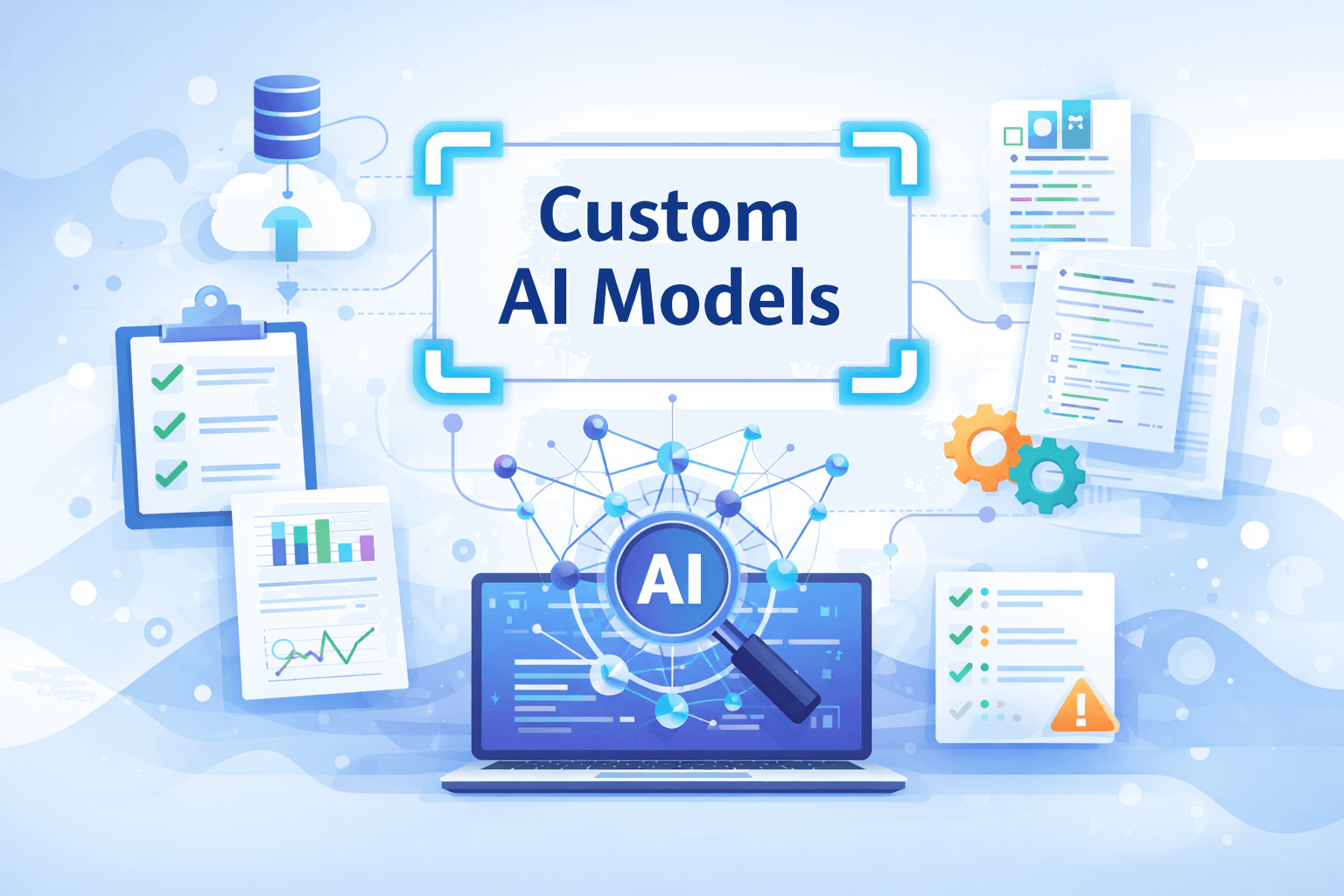
Custom AI Models
Generic AI tools are impressive in demos, but most businesses need something more specific: models and agents that understand your domain, connect to your systems, and produce outputs you can trust.
Enterflow builds custom AI models and AI-powered workflows—from retrieval-augmented generation (RAG) to multi-step agents—designed around your data, processes, and compliance requirements.
What “Custom AI Models” means in practice
We deliver AI that is usable in production—not just prompts.
Typical outcomes include:
Domain-aware assistants for internal teams (support, ops, finance, legal)
Automated document/email workflows (triage, routing, drafting, extraction, validation)
Search and knowledge systems that answer questions grounded in your sources (RAG)
Classification and enrichment (tagging, prioritization, entity extraction, normalization)
Decision support with explainable outputs and confidence signals
AI agents that execute multi-step tasks across your tools (with guardrails)
For non-technical stakeholders: this is AI that reduces manual work, shortens cycle times, and standardizes quality.
For technical stakeholders: this is a production-grade system with observability, evaluation, and controllable risk.
Where it delivers ROI fastest (use cases)
If your team spends time searching, summarizing, replying, routing, or reconciling information, custom AI typically pays off quickly in:
Customer support & success: faster resolution, better triage, consistent answers
Sales & rev ops: lead qualification, account research, proposal and email drafting
Operations: SOP guidance, incident summaries, workflow automation
Finance: invoice/PO support, anomaly detection, narrative reporting
Legal & compliance: contract Q&A, policy checks, evidence packet summaries
Internal knowledge: “Ask your company” search across docs, tickets, wikis, CRM
How we build it (clear enough for non-technical teams)
Our approach is designed to produce reliable outcomes and reduce risk:
Use-case definition: success metrics, failure modes, scope boundaries
Data mapping: where truth lives (docs, CRM, ticketing, ERP, databases)
Solution architecture: select patterns (RAG, tool-using agent, classifier, fine-tune)
Guardrails & policy: privacy, access control, allowed actions, escalation paths
Evaluation & QA: test sets, acceptance thresholds, regression checks
Integration & rollout: API, UI, Slack/Teams, browser extensions, or embedded workflows
Monitoring & iteration: production telemetry and continuous improvement
Tech stack (for technical stakeholders)
We implement modern LLM application infrastructure, typically including:
LLM orchestration & agent tooling
LangChain for chains, tools, agents, and workflow orchestration
LangSmith for tracing, debugging, evaluation, and monitoring in production
Optional: graph-based orchestration (e.g., agent graphs) when workflows require state and branching
Retrieval-Augmented Generation (RAG)
Embeddings + vector search with chunking strategies tuned for your content
Vector stores such as pgvector (Postgres), Pinecone, Weaviate, or OpenSearch (based on your constraints)
Hybrid retrieval (vector + keyword) when precision matters
Re-ranking and citation/grounding patterns to reduce hallucinations
Models & deployment flexibility
Support for leading model providers and open-source models depending on requirements
Optional fine-tuning or domain adaptation when RAG alone is not sufficient
Deployment options: cloud, VPC, or on-prem depending on data sensitivity
Quality, safety, and reliability
Prompt/version management
Automated evaluation harnesses (golden datasets, regression tests)
Rate limiting, caching, and failover strategies
Access control and audit logging (especially for tool-using agents)
Security and compliance by design
We support enterprise-grade safeguards, including:
Data minimization and purpose limitation
Role-based access and secret management
Configurable retention and deletion policies
Environment isolation (dev/staging/prod)
Contractual processor commitments (DPA where applicable)
As a default posture: your data is used only to deliver your solution unless explicitly agreed otherwise.
The “key data” we track (so success is measurable)
We define and monitor metrics that matter to both leadership and engineering:
Task success rate (did the AI complete the job correctly?)
Human escalation rate (what percentage needs review?)
Answer groundedness (supported by internal sources vs. unsupported claims)
Latency (time-to-first-token and end-to-end task time)
Cost per task (and savings vs. manual effort)
User adoption (usage frequency, satisfaction feedback, deflection rates)
When to choose RAG vs. fine-tuning vs. agents
A practical rule of thumb:
RAG when the “truth” lives in your documents/systems and must be cited
Fine-tuning when you need consistent style/format or specialized behavior at scale
Agents when the work requires multi-step actions across tools (with approvals and guardrails)
We often combine these patterns—for example, a RAG-backed agent that can search your knowledge base, draft a response, and create a ticket, while keeping humans in control.
Ready to build something that works in production?
If you share:
your target workflow,
2–3 example inputs (docs, tickets, emails),
and the systems you want to integrate (CRM, helpdesk, ERP, Slack/Teams),
we can propose an architecture, rollout plan, and measurable success criteria.
Contact: info@enterflow.ai
Website: https://enterflow.ai/
Custom AI Models
Generic AI tools are impressive in demos, but most businesses need something more specific: models and agents that understand your domain, connect to your systems, and produce outputs you can trust.
Enterflow builds custom AI models and AI-powered workflows—from retrieval-augmented generation (RAG) to multi-step agents—designed around your data, processes, and compliance requirements.
What “Custom AI Models” means in practice
We deliver AI that is usable in production—not just prompts.
Typical outcomes include:
Domain-aware assistants for internal teams (support, ops, finance, legal)
Automated document/email workflows (triage, routing, drafting, extraction, validation)
Search and knowledge systems that answer questions grounded in your sources (RAG)
Classification and enrichment (tagging, prioritization, entity extraction, normalization)
Decision support with explainable outputs and confidence signals
AI agents that execute multi-step tasks across your tools (with guardrails)
For non-technical stakeholders: this is AI that reduces manual work, shortens cycle times, and standardizes quality.
For technical stakeholders: this is a production-grade system with observability, evaluation, and controllable risk.
Where it delivers ROI fastest (use cases)
If your team spends time searching, summarizing, replying, routing, or reconciling information, custom AI typically pays off quickly in:
Customer support & success: faster resolution, better triage, consistent answers
Sales & rev ops: lead qualification, account research, proposal and email drafting
Operations: SOP guidance, incident summaries, workflow automation
Finance: invoice/PO support, anomaly detection, narrative reporting
Legal & compliance: contract Q&A, policy checks, evidence packet summaries
Internal knowledge: “Ask your company” search across docs, tickets, wikis, CRM
How we build it (clear enough for non-technical teams)
Our approach is designed to produce reliable outcomes and reduce risk:
Use-case definition: success metrics, failure modes, scope boundaries
Data mapping: where truth lives (docs, CRM, ticketing, ERP, databases)
Solution architecture: select patterns (RAG, tool-using agent, classifier, fine-tune)
Guardrails & policy: privacy, access control, allowed actions, escalation paths
Evaluation & QA: test sets, acceptance thresholds, regression checks
Integration & rollout: API, UI, Slack/Teams, browser extensions, or embedded workflows
Monitoring & iteration: production telemetry and continuous improvement
Tech stack (for technical stakeholders)
We implement modern LLM application infrastructure, typically including:
LLM orchestration & agent tooling
LangChain for chains, tools, agents, and workflow orchestration
LangSmith for tracing, debugging, evaluation, and monitoring in production
Optional: graph-based orchestration (e.g., agent graphs) when workflows require state and branching
Retrieval-Augmented Generation (RAG)
Embeddings + vector search with chunking strategies tuned for your content
Vector stores such as pgvector (Postgres), Pinecone, Weaviate, or OpenSearch (based on your constraints)
Hybrid retrieval (vector + keyword) when precision matters
Re-ranking and citation/grounding patterns to reduce hallucinations
Models & deployment flexibility
Support for leading model providers and open-source models depending on requirements
Optional fine-tuning or domain adaptation when RAG alone is not sufficient
Deployment options: cloud, VPC, or on-prem depending on data sensitivity
Quality, safety, and reliability
Prompt/version management
Automated evaluation harnesses (golden datasets, regression tests)
Rate limiting, caching, and failover strategies
Access control and audit logging (especially for tool-using agents)
Security and compliance by design
We support enterprise-grade safeguards, including:
Data minimization and purpose limitation
Role-based access and secret management
Configurable retention and deletion policies
Environment isolation (dev/staging/prod)
Contractual processor commitments (DPA where applicable)
As a default posture: your data is used only to deliver your solution unless explicitly agreed otherwise.
The “key data” we track (so success is measurable)
We define and monitor metrics that matter to both leadership and engineering:
Task success rate (did the AI complete the job correctly?)
Human escalation rate (what percentage needs review?)
Answer groundedness (supported by internal sources vs. unsupported claims)
Latency (time-to-first-token and end-to-end task time)
Cost per task (and savings vs. manual effort)
User adoption (usage frequency, satisfaction feedback, deflection rates)
When to choose RAG vs. fine-tuning vs. agents
A practical rule of thumb:
RAG when the “truth” lives in your documents/systems and must be cited
Fine-tuning when you need consistent style/format or specialized behavior at scale
Agents when the work requires multi-step actions across tools (with approvals and guardrails)
We often combine these patterns—for example, a RAG-backed agent that can search your knowledge base, draft a response, and create a ticket, while keeping humans in control.
Ready to build something that works in production?
If you share:
your target workflow,
2–3 example inputs (docs, tickets, emails),
and the systems you want to integrate (CRM, helpdesk, ERP, Slack/Teams),
we can propose an architecture, rollout plan, and measurable success criteria.
Contact: info@enterflow.ai
Website: https://enterflow.ai/
Contact us
info@enterflow.ai
EnterFlow AI empowers you to unlock your business potential with AI OCR models
Vienna, Austria
Contact us
info@enterflow.ai
EnterFlow AI empowers you to unlock your business potential with AI OCR models
Vienna, Austria
Contact us
info@enterflow.ai
EnterFlow AI empowers you to unlock your business potential with AI OCR models
Vienna, Austria